
Selecting the Right Sensor Suite for Industrial Monitoring
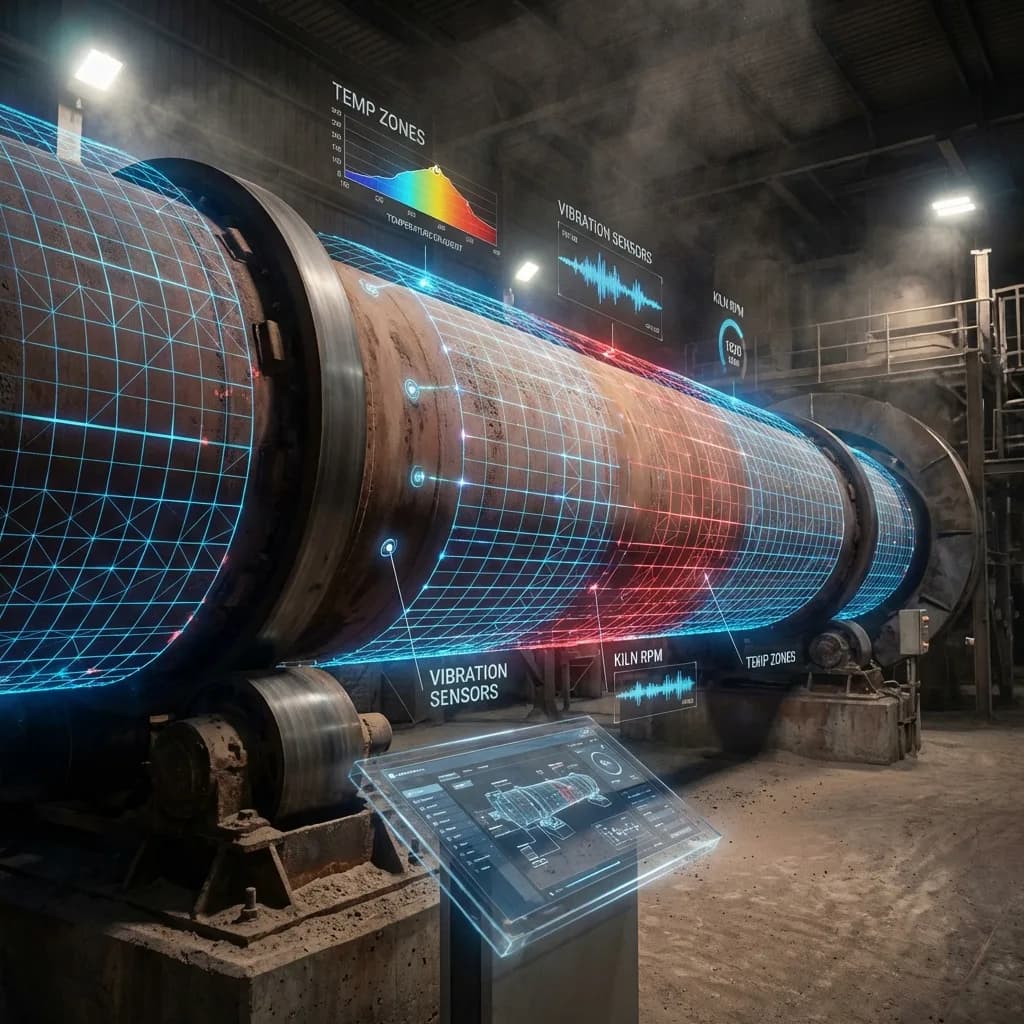
## A Practical Guide for Cement Kilns
Cement kilns are among the harshest industrial environments on the planet. Extreme temperatures, abrasive dust, continuous vibration, corrosive gases, and 24/7 operation make monitoring not just useful—but essential. The right sensor suite can be the difference between stable production and an unplanned shutdown costing hundreds of thousands of dollars.
This article focuses on how to select the right combination of sensors specifically for cement kiln monitoring, based on real operational needs rather than generic instrumentation theory.
Why Sensor Selection Matters in Cement Kilns
Unlike many industrial processes, cement kilns are:
- Thermally aggressive (up to 1,450 °C in the burning zone)
- Mechanically massive (rotating shells, tyres, rollers, girth gears)
- Continuously loaded (minimal downtime tolerated)
- Sensitive to alignment and material flow
A poorly chosen sensor may survive on paper—but fail in weeks in real kiln conditions. Selection must balance robustness, accuracy, response time, maintainability, and data relevance.
Core Sensor Categories for Cement Kiln Monitoring
1. Temperature Sensors – Seeing Inside the Fire
Temperature is the heartbeat of the kiln process.
Where temperature matters most:
- Burning zone
- Kiln shell
- Preheater cyclones
- Cooler inlet and outlet
- Bearings and gearboxes
Recommended technologies:
- Infrared (IR) scanners for full kiln shell profiling
- Thermocouples (Type K / Type S) for high-temperature zones
- RTDs (PT100/PT1000) for bearings and auxiliary equipment
Key selection criteria:
- Measurement range (continuous vs peak)
- Dust and emissivity compensation (for IR systems)
- Mechanical protection (sheathing, mounting)
- Calibration stability over long periods
💡 Shell temperature trends often reveal refractory failure long before visual inspection does.
2. Vibration Sensors – Predicting Mechanical Failure
Rotating kiln components are slow, massive, and unforgiving.
Critical monitoring points:
- Support rollers
- Girth gear and pinion
- Main drive gearbox
- ID/FD fans
- Cooler drives
Sensor types to consider:
- Industrial MEMS accelerometers (robust, low power, good for continuous monitoring)
- Piezoelectric accelerometers (high-frequency fault detection)
- Velocity sensors (for traditional ISO-based diagnostics)
What really matters:
- Low-frequency sensitivity (kilns rotate slowly)
- High shock survivability
- Long-term stability (months or years without recalibration)
- Mounting method (stud-mounted beats magnetic in harsh zones)
💡 In kilns, trend stability is often more valuable than absolute vibration amplitude.
3. Pressure and Draft Sensors – Controlling the Flow
Draft control is essential for combustion efficiency and emissions.
Typical applications:
- Kiln inlet and outlet pressure
- Preheater draft
- Baghouse differential pressure
- Cooler under-grate pressure
Sensor recommendations:
- Differential pressure transmitters with dust-tolerant impulse lines
- Low-range pressure sensors with high resolution
Selection tips:
- Overpressure protection (pressure spikes happen)
- Purge or self-cleaning capability
- Long-term zero stability
4. Gas and Emissions Sensors – Compliance and Optimization
Modern kilns are tightly regulated.
Commonly measured gases:
- O₂ (combustion efficiency)
- CO (incomplete combustion / safety)
- NOₓ, SO₂ (environmental compliance)
Technology choices:
- Zirconia O₂ analyzers (fast, high-temperature capable)
- NDIR gas analyzers for CO and CO₂
- Extractive vs in-situ systems depending on dust load
Critical considerations:
- Sample conditioning quality
- Sensor drift and calibration intervals
- Response time vs measurement stability
5. Position and Alignment Sensors – The Silent Protectors
Misalignment kills kilns slowly—and expensively.
Used for:
- Kiln axis alignment
- Roller skew detection
- Thrust monitoring
- Shell deformation analysis
Typical solutions:
- Laser-based alignment systems
- Linear displacement sensors (LVDTs)
- Optical or encoder-based position sensors
💡 Alignment data doesn’t need to be continuous—but when you need it, it must be accurate.
Environmental and Mechanical Realities to Respect
When selecting any sensor for a cement kiln, always ask:
- Can it survive cement dust ingress?
- Is it rated for continuous vibration?
- What happens at 150 °C ambient, not just in the datasheet lab?
- Can maintenance replace it without stopping the kiln?
- How will cabling, connectors, and junction boxes age?
Very often, connectors and cables fail before sensors do.
Data Quality Over Sensor Quantity
More sensors do not automatically mean better monitoring.
A well-designed sensor suite should:
- Capture process health, not just raw signals
- Enable trend-based maintenance, not alarms-only
- Integrate cleanly with PLC, SCADA, or edge analytics
- Provide actionable insights, not data overload
Edge processing (local RMS, FFT, thermal gradients, rate-of-change metrics) can drastically reduce noise and improve reliability.
Final Thoughts
Selecting the right sensor suite for cement kiln monitoring is not about chasing the most advanced technology—it’s about choosing the right tools for a brutal environment.
The best systems are:
- Purpose-built for cement plants
- Conservative in design, smart in analytics
- Easy to maintain, hard to kill
- Focused on trends, not just thresholds
When sensors are chosen correctly, they don’t just measure the kiln—they protect it, optimize it, and extend its life.
Need help selecting the right product?
Talk directly with an engineer about your requirements. We typically respond within 1 business day.