
Medical Device Cybersecurity: Regulations & Best Practices
## Introduction
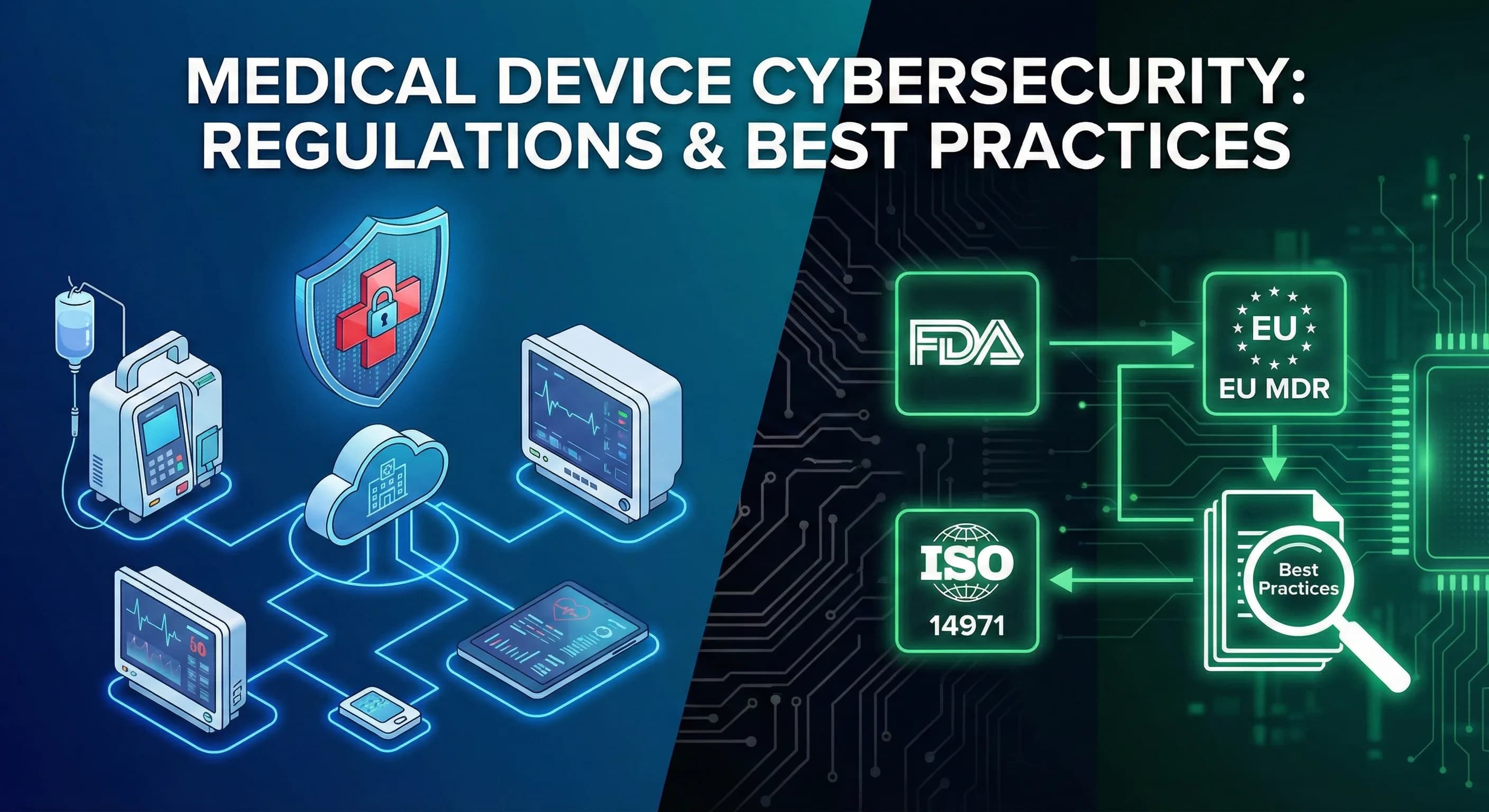
Medical devices are no longer isolated pieces of hardware. From infusion pumps and patient monitors to implantable devices and remote diagnostic systems, modern medical technology is deeply connected to hospital networks, cloud platforms, and mobile applications. This connectivity improves patient outcomes, but it also expands the attack surface. Cybersecurity is now a patient safety issue, not just an IT concern.
This article walks step by step through why medical device cybersecurity matters, the key regulations, and best practices manufacturers should follow across the product lifecycle.
1. Why Medical Device Cybersecurity Matters
Cyber incidents involving medical devices can lead to:
- Patient harm (incorrect dosage, delayed therapy, false readings)
- Data breaches (protected health information - PHI)
- Operational disruption (devices taken offline, hospital downtime)
- Regulatory non-compliance and product recalls
Unlike traditional IT systems, medical devices often:
- Have long lifecycles (10-20 years)
- Run on constrained hardware
- Cannot be frequently patched without re-validation
- Operate in safety-critical environments
This makes secure-by-design approaches essential.
2. Key Regulations and Standards
2.1 FDA (United States)
The FDA treats cybersecurity as part of device safety and effectiveness.
Key guidance documents include:
- Content of Premarket Submissions for Management of Cybersecurity in Medical Devices
- Postmarket Management of Cybersecurity in Medical Devices
Core expectations:
- Threat modeling and risk analysis
- Secure software updates
- Vulnerability disclosure processes
- Software Bill of Materials (SBOM)
2.2 European Union - MDR & IVDR
Under the Medical Device Regulation (MDR) and IVDR, cybersecurity is embedded into:
- General Safety and Performance Requirements (GSPR)
- Risk management and software lifecycle controls
Manufacturers must show:
- Protection against unauthorized access
- Data integrity and availability
- Resilience against foreseeable misuse
2.3 ISO / IEC Standards
Important harmonized standards include:
- ISO 14971 - Risk management
- IEC 62304 - Medical device software lifecycle
- IEC 81001-5-1 - Cybersecurity for health software and networks
- ISO/IEC 27001 - Information security management systems
These standards translate regulatory expectations into engineering practices.
3. Cybersecurity Best Practices (Step by Step)
3.1 Secure by Design (Not Afterthought)
Cybersecurity must start at architecture definition, not after the device is built.
Best practices:
- Minimize attack surface (disable unused ports, services)
- Apply least-privilege principles
- Separate safety-critical and non-critical software components
- Use hardware security features (secure boot, TPM, secure elements)
3.2 Threat Modeling & Risk Management
Perform structured threat analysis:
- Identify assets (patient data, control commands, firmware)
- Define threat actors (malicious users, insiders, remote attackers)
- Analyze attack vectors (BLE, Wi-Fi, USB, cloud APIs)
Integrate cybersecurity risks into ISO 14971 risk files, not a separate document.
3.3 Secure Communication & Data Protection
Minimum expectations today:
- Encrypted communication (TLS, DTLS)
- Strong authentication and authorization
- Secure key storage
- Data encryption at rest for sensitive information
Avoid:
- Hardcoded credentials
- Plain-text protocols
- Debug interfaces left enabled in production
3.4 Software Updates & Patchability
Regulators expect devices to be maintainable.
Best practices:
- Secure firmware update mechanisms
- Cryptographic signature verification
- Rollback protection
- Clear update policies communicated to users
A device that cannot be safely updated is considered high risk.
3.5 Vulnerability Management & Disclosure
Manufacturers should:
- Maintain a vulnerability intake process
- Monitor CVEs affecting third-party components
- Provide coordinated vulnerability disclosure (CVD)
- Communicate transparently with regulators and customers
This is now an explicit FDA and EU expectation.
3.6 Documentation & Evidence
Cybersecurity must be demonstrable, not just implemented.
Typical evidence includes:
- Threat models
- Penetration test reports
- SBOMs
- Secure development lifecycle (SDL) procedures
- Post-market surveillance plans
These documents are reviewed during audits and technical file assessments.
4. Common Mistakes to Avoid
- Treating cybersecurity as only an IT problem
- Ignoring post-market responsibilities
- Using outdated cryptography due to legacy constraints
- Underestimating BLE, USB, or maintenance ports as attack vectors
- Failing to align cybersecurity risks with patient safety risks
5. Looking Ahead
Medical device cybersecurity is evolving rapidly:
- Regulators are increasing scrutiny
- Hospitals demand stronger security assurances
- Software-heavy and connected devices are becoming the norm
Manufacturers that invest early in cybersecurity reduce:
- Regulatory risk
- Recall probability
- Long-term maintenance cost
- Brand and patient trust damage
Final Thought
Cybersecurity is no longer optional or "nice to have." In medical devices, security is safety. Building secure systems from the ground up is not just about compliance, it is about protecting patients in an increasingly connected healthcare world.
Need help with a similar project?
Talk directly with an engineer about your requirements. We typically respond within 1 business day.
Related insights
A deep dive into LOOP, a portable and reusable NPWT platform focused on mobility, safety, adaptive therapy, and remote care readiness.
Distinguishing central from obstructive apneas prevents pressure chasing, improves interpretation, and guides safer CPAP therapy decisions.
Low-power embedded systems are reshaping industrial reliability, edge intelligence, and long-life sensing in the field.